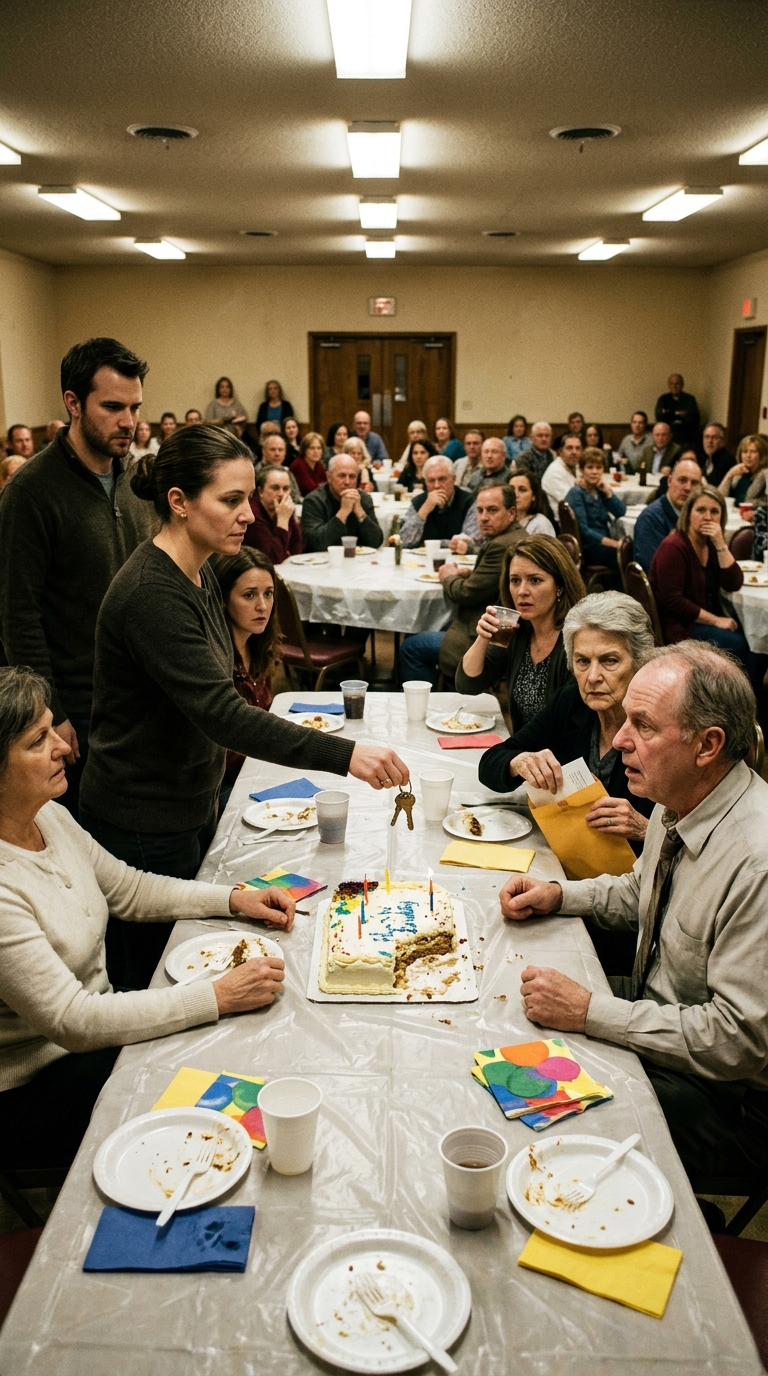
By the time my father lifted his wine glass and joked that I would never be able to afford a house because I could barely afford lunch, forty people were already looking at me the way people look at a family story they think they know by heart.
The laugh landed in stages.
A few people barked it out immediately, eager and loud, the way people laugh when they want the man at the head of the table to notice them. A few gave that delayed, uncertain chuckle that belongs more to self-protection than humor. A few kept chewing and looked down at their plates, because even in a room built for performance there are always one or two people who know when something ugly has just been dressed up as entertainment.
My boyfriend, Nathan, tightened his hand around mine under the folding banquet table.
I smiled.
I smiled because sometimes a smile is not agreement. Sometimes it is just a door you close from the inside while you decide whether this is the moment you finally stop being polite.
I’m Myra. I turned thirty that night. And if you have ever been made into the family lesson, the family concern, the family “project,” then you already know there is a special exhaustion that comes from watching people laugh at a version of you that was built by someone else.
The room was the fellowship hall behind First Mercy Community Church, the same multipurpose room where people held baby showers, potlucks, after-funeral lunches, retirement parties, pancake breakfasts, and the kind of birthday dinners that were less about celebration than witness. It smelled like grocery-store frosting, baked ham, sweet tea, coffee that had been sitting too long, and that lemony floor cleaner churches always smell like, as if holiness might be one good mop away.
On the far wall, somebody had taped up a crooked gold banner that read HAPPY 30TH BIRTHDAY, MYRA. My aunt Helen’s handwriting was on the little place cards next to the desserts. My father’s influence was on everything else. The guest list. The seating. The way his friends from real estate and Rotary Club somehow outnumbered my actual friends. The way his voice carried, always just a little too easily, as if air had always agreed to move out of his way.
He stood at the end of the longest table with a paper plate in one hand and the wine glass in the other, his tie loosened half an inch in that calculated way men do when they want to suggest warmth without surrendering authority. Gerald Mercer. My father. Sixty-one years old, silver at the temples, pressed button-down shirt, easy smile, the kind of man who could make a stranger tell him their mortgage worries in under five minutes and then walk away feeling grateful for the privilege.
He had sold houses in our county for thirty years. Not the glamorous kind you see in magazines. Split-levels, ranch homes, farm parcels, brick colonials with outdated kitchens, starter homes with cracked driveways and hopeful descriptions in the listing. In our town, Gerald knew who was divorcing before the court record updated, who was downsizing, who was overleveraged, who inherited land, who was bluffing prosperity and who wasn’t. He liked information because information let him narrate people before they had a chance to narrate themselves.
And for eight years, he had narrated me.
“She’s still figuring things out,” he would tell people with a tolerant smile.
“Myra has such a big heart, but no head for planning.”
“She’s working hard, bless her.”
“She’s in one of those phases.”
If somebody asked where I lived, he knew before I answered.
If somebody asked how I was doing, he answered with concern so polished it looked like care.
If a relative sent a check, a casserole, an offer of help, a prayer, advice, or pity, somehow it always traveled through him first, as if I were not a grown woman with a phone, a mailbox, and a spine.
Across the table from me, my sister Brenda gave one fast little laugh when he made the joke, then covered it with her wineglass. I watched the exact second she realized the line had gone too far. Brenda was twenty-eight, blond in that glossy, careful way that always made older women say, “She just looks put together,” and men say, “She’s got good sense.” She had been our father’s favorite not because he loved her more—I am old enough now to know favoritism is not love—but because she made his life easier. She stayed close. She accepted the terms. She understood the choreography. She had mastered the art of receiving his help without asking what it cost.
Nathan leaned slightly toward me. “You want to go?” he whispered.
I shook my head.
Not yet.
Because in the inside pocket of my coat, draped over the back of my chair, there was a set of brass keys still warm from my hand.
And tucked into the other pocket, inside an envelope creased soft with age, were my mother’s words.
My father was still smiling, still basking in the ripple of laughter he had created. “Hey, I’m kidding,” he said to the room, though the sound of his own voice told me he wasn’t. “She knows I’m kidding. Right, sweetheart?”
Sweetheart.
He had not called me that in private in years. Public tenderness was one of his strongest habits. He used it like a witness.
I looked at him for a long beat, and maybe something in my face shifted, because the room went quieter than a fellowship hall ever really gets. Even the children at the dessert table seemed to lower themselves into the background. A fork clicked against a plate. Ice settled in a plastic cup. Somebody near the coffee urn coughed and then regretted it.
“Actually,” I said, and my own voice surprised me with how steady it sounded, “about that.”
I reached behind me for my coat, slid my hand into the pocket, and brought out the keys.
I placed them in the middle of the table between the paper plates and candle wax and the half-eaten sheet cake, and the small metallic sound they made on the plastic tablecloth was somehow louder than his toast had been.
My father’s grin stayed in place for exactly one second too long.
Then it trembled.
Not much. Most people in that room probably missed it. But I had spent my entire life watching his face for weather. I saw it.
He looked down at the keys, then back at me. “Where is it?” he asked, like this was still a game he could win if he made the next move casually enough.
Before I answered, I heard the soft, deliberate click of a purse clasp opening.
That sound came from three chairs down, where Aunt Helen sat with her napkin folded into a perfect square on her lap and her reading glasses hanging from a thin silver chain against her blouse. She was my mother’s older sister by seven years and, unlike most women in our family, had never once mistaken silence for peace. She was the kind of woman who ironed pillowcases, returned library books early, read ingredient lists out of habit, and kept records because records were what remained when charm ran out.
Most people in town thought of her as gentle.
That was because most people had never given her a reason to become precise.
When her purse opened, my father’s eyes moved toward her, and for the first time that evening I saw something sharper than irritation in his face.
Not anger.
Alarm.
Eight years earlier, when I was twenty-two, the house still smelled like funeral food when my father called what he referred to as a family meeting.
My mother had been dead for five days.
Her name was Evelyn Mercer, and if my father was the kind of person who could fill a room without effort, my mother was the kind who made rooms feel less hostile just by standing in them. She was not dramatic. She was not loud. She was not one of those women who made sacrifice into a performance. She remembered people’s allergies, favorite soups, the exact date their son came home from deployment, the name of the dog that died in ninth grade and the aunt whose birthday no one else remembered. When Brenda was in middle school and had a meltdown over a bad perm an hour before school pictures, it was my mother who fixed her hair. When my father got the flu one Christmas Eve and insisted it was just a cold, she was the one who put a bucket beside the recliner before he admitted he needed one. When I was sixteen and drove home after being rear-ended at a stoplight with my whole body shaking, it was my mother who sat on the edge of my bed until I fell asleep, not because I had said I was scared, but because she could hear fear in the way I set my shoes down.
She handled the soft stuff, my father liked to say.
What he meant was that she handled all the invisible labor that allowed him to appear competent in public without ever learning how much effort competence really takes.
She got sick slowly, then all at once.
At first it was just fatigue. Then appointments. Then scans. Then treatment schedules on the refrigerator and insurance forms stacked under the bread box and everybody talking in lowered voices as if quietness itself could bargain with disease. Brenda stayed in school and cried a lot and clung to my mother at the right times. My father made phone calls, explained things to people, updated the church prayer chain, and said words like options and specialists and aggressive while I drove my mother to Tuesday chemo appointments in a Honda with a broken passenger-side vent and learned where the vending machines were on the oncology floor.
I had been in community college then, taking classes part-time and working evenings at a restaurant. Nothing glamorous. I was not one of those people born with a perfectly shaped ambition. I liked numbers. I liked order. I liked making lists and balancing columns and figuring out why things didn’t match. But I was twenty-one, then twenty-two, and when your mother is dying in stages, the future stops behaving like a staircase and starts behaving like weather. I dropped a class. Then another. I picked up more shifts. I told myself I would go back when things stabilized.
Things did not stabilize.
My father never forgave me for not remaining impressive enough while my mother was dying.
He never said it that way, of course. My father was too polished to speak his ugliest truths in plain language. But he began saying little things in that season, small sharp things delivered with concern.
“Brenda’s still keeping her scholarship intact. That’s discipline.”
“You can’t keep putting your life on pause, Myra.”
“Some people function better under pressure than others.”
He said these things in the kitchen while I sorted pills, in the car while I drove us home from appointments, at the dining room table while my mother slept in the den recliner because climbing the stairs had become too much. He said them in front of her less often. My mother’s eyes got tired, but they did not get dull. She heard more than he thought she did.
Once, maybe three weeks before she died, I was standing at the sink rinsing out the blender because she could only keep down smoothies that month. My father was behind me at the table paying bills, and Brenda was upstairs FaceTiming a friend from her room with the door shut. I remember the light that afternoon because it was the kind of thin October light that makes everything look both tired and too clear.
My father said, “I’m just saying there’s only so much support to go around. Brenda has a plan.”
My mother looked up from the recliner.
There are moments in a life when the temperature changes without the weather doing anything at all. That room changed.
My mother’s voice, when it came, was so quiet my father had to lean toward her. “Myra has been driving me to treatment.”
He shifted in his chair. “I know that.”
“She has been buying groceries.”
“I know that too.”
“She has been cleaning the bathroom after I get sick in it.”
No answer.
“She has been carrying the soft stuff,” my mother said.
My father’s mouth tightened. “Evelyn, I’m trying to talk practically.”
“No,” she said. “You are trying to make practicality sound noble.”
I still remember the way my hands froze around the blender lid.
My father gave a humorless little laugh, the one that meant he had already moved into resentment. “What would you like me to do? Hand out money because guilt makes us feel generous?”
My mother leaned back against the chair, and even sick she managed to look at him in a way that made the room tell the truth. “I would like you,” she said, “to stop acting as if only one kind of labor counts because it happens to be the kind that flatters you.”
He stared at her, then at me, and something old and mean passed briefly across his face.
The subject changed after that.
But the sentence stayed.
She died on a Monday morning in early November with the bedroom curtains half-open and rain ticking softly against the windows. I was the one in the room with her when the nurse glanced at the monitor and changed her expression. My father had gone downstairs to answer a call. Brenda had finally fallen asleep on the chaise in the den. I was holding my mother’s hand and telling her that the soup from St. Mark’s ladies group really was terrible and yes, I knew she’d hate that I said so, but if she could hear me maybe she could at least agree with me silently.
Her hand moved once inside mine.
Afterward, the next week unfolded exactly the way grief weeks do in families that already had cracks in them before death arrived. People brought food. People cried in hallways. People praised my father’s strength. People told Brenda she looked so much like her mother. I loaded dishwashers and took casseroles out of foil pans and accepted hugs from women who smelled like perfume and peppermint and said things like, “Your mom worried about you girls so much.”
I wanted to ask which girl.
Not because my mother loved one of us more. She didn’t.
But because love is not the same as worry, and my mother had worried about me in a different way. Not because she thought I would fail. Because she knew what kind of family I was trying to remain soft inside.
The Friday after the funeral, my father called us to the kitchen table.
The lilies from the service were still dropping pollen. The sympathy cards were stacked in a shoebox near the microwave. There were four placemats on the table because my mother had set four there for years and no one had yet been brave enough to move them.
My father stood at the head of the table with a legal pad.
He did not sit.
That should have told me everything.
“Your mother handled the soft stuff,” he said, in a voice so rehearsed I knew he had been waiting to say it. “I handle the money. Things are going to be more structured around here.”
Brenda, red-eyed and thin from grief, nodded almost immediately. She always nodded first when she was scared.
I sat across from her and folded my hands together under the table to keep from doing anything visible with them.
My father glanced at the legal pad as if he needed notes for our lives.
“Brenda’s tuition will continue. We want consistency there. Her car insurance too. She’s on track.”
Brenda looked relieved before she looked guilty. That, more than anything, made me ache for her. She had learned so young that security was often awarded in front of an audience and always with conditions attached.
Then my father turned to me.
“You,” he said, “need to figure yourself out first.”
Just like that.
No transition.
No room for interpretation.
No mention of the classes I had dropped because someone had to drive Mom to appointments. No mention of the shifts I had picked up because my mother couldn’t stand long enough to cook and my father’s version of helping was ordering takeout and acting burdened by gratitude. No mention of the nights I sat on the bathroom floor with my mother because she was too dizzy to make it back to bed alone. No mention of the fact that my grief was not just grief. It was exhaustion wearing grief’s coat.
“What does that mean?” I asked.
My father pressed his lips together, then opened them in what he must have believed was patience. “It means I’m not financing drift.”
“I wasn’t drifting.”
He spread a hand. “Myra, you dropped classes.”
“I dropped classes because Mom was sick.”
Brenda looked down at the table.
My father’s jaw hardened. “You dropped classes because you don’t commit unless the circumstances flatter you.”
Even now, years later, I can feel the shock of that sentence in my ribs.
Not because it was the cruelest thing anyone had ever said to me. Life gets longer than that.
But because it told me, with perfect clarity, what my father had seen all along when he looked at me.
Not a daughter.
Not even a disappointment.
A problem in need of a framing.
I said, “I’ve been working.”
He shrugged. “A few restaurant shifts is not a plan.”
I laughed then, but it came out wrong, brittle and unbelieving. “So driving Mom to chemo wasn’t a plan. Buying groceries wasn’t a plan. Keeping this house going wasn’t a plan. But Brenda staying untouched by all of it was?”
Brenda’s head lifted. “That’s not fair.”
I turned to her. “Isn’t it?”
She flushed and crossed her arms. “I didn’t ask her to protect me.”
“No,” I said. “You just let it happen.”
My father slapped his hand flat against the table, just once, a warning sound. “Enough.”
I stood up so quickly my chair scraped back into the wall.
He looked at me with something like triumph hiding under annoyance. He wanted me angry. Anger made me easier to summarize later.
“If you’re going to cut me off,” I said, “just say you’re cutting me off.”
“I am saying,” he replied, “that grown adults who want independence should start by earning it.”
The room went very quiet.
Because if you listened only to the words, he sounded reasonable.
That was his gift.
He could weaponize tone so well that other people mistook it for truth.
I looked at Brenda one more time, hoping—not for rescue, not even for support, just for witness.
She stared at her lap.
So I picked up my coat from the hook by the back door and left the kitchen without another word.
On the hall table beside the front door, under a stack of sympathy cards and church bulletins, there was a cream-colored envelope with my name on it in my mother’s handwriting.
For Myra.
Nothing else.
Aunt Helen had dropped it off that morning and said, “Your mother asked me to give you this when the house got too loud.”
I took it with me.
I did not open it.
I moved out eleven days later.
The apartment I found was over a laundromat on Miller Street and had the kind of narrow stairs that made moving a mattress feel like an accusation. The carpet was worn flat in the hallway. The kitchen window stuck in damp weather. The radiator hissed like it disapproved of me. The rent was cheap if you did not ask what cheap cost in comfort.
I did not ask.
I worked mornings at Penny’s Diner and evenings at a bar called River’s Edge where men in work boots ordered domestic beer and told the same stories in different shirts. I came home smelling like grease, coffee, citrus cleaner, and other people’s weekends. I paid rent in money folded from apron tips. I bought generic cereal, eggs, frozen vegetables, and coffee that came in a can. I learned which utility bills could wait three days and which ones couldn’t. I cried in the shower because it was the only place loud enough to hide the sound from myself.
My father called twice in the first month.
Both times he left voicemails that sounded like obligations.
“Just checking in.”
“Hope you’re keeping your head above water.”
“Let me know if you get serious about making a plan.”
I did not call back.
Brenda texted more often, but her texts always felt like messages from a country I used to live in.
Dad says you’re doing okay.
Are you mad at me?
Can we not make this worse?
At Thanksgiving, I went to Aunt Helen’s instead of home.
At Christmas, I split the day between a double shift and a microwaved plate of leftovers standing at my own counter because I could not bear the idea of sitting alone at a table set for one. Around eight that evening, my father sent a photo of himself, Brenda, and two neighbors in front of the tree with the caption: Missed you today. Come home when you’re ready to act like family.
I stared at it until the screen dimmed, then set the phone face down and washed the same coffee mug twice because my hands needed something to do.
The envelope in my top drawer stayed sealed.
Some nights I would take it out and trace my mother’s handwriting with my thumb. The paper had a faint scent of her perfume trapped in it at first, something clean and powdery and impossible. Then time took that too, and it just became paper. I told myself I would open it when I could survive hearing from her in the past tense.
I could not.
So I built a life around the unopened space.
What saved me was not one dramatic opportunity or one heroic decision.
It was boredom, mostly.
Or maybe not boredom. Repetition with dignity.
It turned out that when nobody is narrating your life for you, you can get very interested in the small mechanics of improvement. I had always liked numbers. At the diner, I noticed which servers under-reported tips by accident and which ones did it by strategy. At the bar, I kept seeing owners argue over invoices because no one had tracked them correctly. I started making little columns in a notebook. Sales. Labor. Waste. Inventory. What was coming in. What was leaking out. What looked like chaos if you stared at the whole thing but made perfect sense if you laid it out line by line.
One night after a shift, I saw an ad for an online bookkeeping certification course on the community college website.
The tuition was low enough to be imaginable if I skipped eating anything fun for a while.
So I enrolled.
I took the course between calls when I later got a day job at a cable company customer service center, headset on, apologizing to strangers about outages while another tab stayed open with accounting modules and quiz questions about receivables, accruals, depreciation, and reconciliation. I learned QuickBooks. I learned payroll basics. I learned how to read balance sheets without feeling like the numbers were judging me. I learned that I was good at this. Not accidentally. Not “for someone like me.” Just good.
That distinction matters more than people think.
If you grow up in a house where competence is rationed according to usefulness, you can spend years believing that any strength you have is either luck or temporary. There is a strange healing in discovering that your mind settles naturally into certain work. That you are not borrowing aptitude from a better version of yourself. You already have it.
I began taking on side clients. A hairstylist first, then a landscaping company, then the owner of Penny’s Diner, who discovered I could clean up two years of sloppy books in half the time his nephew had spent making them worse. I charged less than I should have because women who are raised to apologize for existing usually underprice themselves at first. But even underpriced money accumulates if you stop telling yourself it doesn’t count.
I saved in envelopes.
Emergency.
Taxes.
Down payment.
Paint.
I labeled them because labels make hope look procedural, and procedure is easier to trust than emotion.
The first time I saw the duplex, it was listed online with six blurry photos and the phrase investor special, which in our county usually meant condemned-adjacent. It sat on Birch Street, three blocks from the elementary school, a sagging two-story brick with overgrown hedges, a porch rail that leaned like it had lost the will to continue, and windows so dirty the whole place looked blind.
It was beautiful to me.
Not because it was pretty.
Because the numbers worked.
The seller was a tired man in Dayton liquidating inherited property. The place needed everything cosmetic and two things structural. The upstairs unit had not been updated since sometime during the reign of mustard yellow. The downstairs bathroom had water damage near the tub. The furnace was older than honesty. But the price was low, the neighborhood stable, the school district decent, and if I lived in one unit while renting the other after repairs, the math came close enough to possible that I could feel my pulse in my throat.
I did not tell my father.
This part matters.
He was a realtor. If I told him, he would know where it was, what it cost, what I should have negotiated, what I had overlooked, what I had misunderstood, what an experienced person would have done differently, and most of all he would find a way to insert himself into the story so that whatever I built could later be described as something I built near him, because of him, under his informed shadow.
So I called a realtor from another town.
I showed up to the viewing in jeans and a thrift-store coat and walked through the duplex with a clipboard because carrying paper steadied me.
The upstairs smelled like old dust and mouse droppings and someone else’s fried onions from years ago. The kitchen linoleum was peeling at the corners. The light fixtures were an insult. The bathroom sink dripped. The walls were nicotine-yellow under wallpaper patterned with tiny grapes.
I fell in love on sight.
Not romantic love.
Recognition.
I knew how to work with ugly things if they still had structure.
I bought it six weeks later with an FHA loan, a down payment that had taken me nearly three years to save, and a terror so bright it practically made the closing documents hum.
The keys to that duplex felt heavier than any object I had ever carried.
I sat in my car outside afterward and cried so hard I had to fog the windows twice before I could drive.
No one from my family knew.
I spent every spare hour inside that place for months. Scraping wallpaper until my shoulders ached. Pulling old carpet. Watching repair videos at midnight. Learning which projects were possible, which ones required humility, and which ones required licensed professionals unless I wanted to die under a lawsuit or a live wire.
That was how I met Nathan.
The downstairs electrical panel failed inspection because one breaker had been doubled in a way that made the city inspector say, “Whoever did this believed in luck more than code.” He gave me a number for a local electrician willing to take small jobs without acting like every woman holding a clipboard was ornamental.
Nathan showed up in a white work van with a ladder on top and a coffee stain on his sleeve. He was tall in the unannounced way some men are, broad-shouldered without seeming proud of it, dark hair a little too long at the back, face sun-browned and serious until he smiled. He looked about thirty and moved like someone who had spent years carrying equipment without seeing any reason to mention it.
He listened.
That was the first thing I noticed.
I walked him through the duplex expecting the usual interruptions and got none. I told him what I had repaired, what I planned to do, what I knew I had no business doing. He asked clear questions. He answered mine without condescension. When I admitted I had watched three videos on replacing outlets and then decided not to risk it, he did not laugh.
“That’s not fear,” he said, crouching in front of the panel. “That’s judgment.”
I stood there with a notebook in my hand and felt something inside me uncurl by half an inch.
After he fixed the panel and replaced two outlets I had wisely declined to touch, he wrote the invoice and handed it to me.
“You doing all this alone?” he asked.
“Mostly.”
He glanced toward the stripped living room with its drop cloths and paint rollers and stacks of trim. “That’s a lot.”
I waited for the usual. The part where a man says it’s ambitious like he means reckless, or says it’s brave like he means foolish, or says you shouldn’t have to like he means he’s impressed you’ve survived what he still assumes you’ll fail.
Instead he said, “Looks like you know what you’re building.”
I still remember how quiet the room got after that sentence.
He asked me out three weeks later after I called him back about a flickering porch light, and if that sounds like an excuse, it was, but not only on my end.
We got coffee first. Then dinner. Then we developed the kind of relationship that feels less like being discovered and more like being accurately read for the first time. Nathan did not overhelp. He did not mistake witnessing my work for doing it on my behalf. He held ladders. He painted trim when asked. He brought sandwiches. He taught me how to use a miter saw without losing my nerve. He argued with me about whether sage green or warm cream made more sense in the upstairs unit, and then admitted I was right after the second coat dried.
When I moved into the downstairs apartment of the duplex with a mattress on the floor and a kitchen table from a yard sale, Nathan carried in the second box, set it down, looked around at the scraped floors and fresh paint and mismatched curtains, and said, “This is the first place I’ve been in all year that feels like somebody meant it.”
No one had ever described anything I built that way.
I loved him a little from that day forward and a lot by the time the upstairs unit was rented to a quiet postal worker named Denise who paid on time and watered my tomato plant when I forgot.
By then, my father’s version of me had become community lore.
You should understand how small towns metabolize a story.
They do not need facts. They need repetition.
And my father was excellent at repetition.
At a graduation party for one of Brenda’s friends, he introduced me to an older couple as “my daughter Myra—she’s still finding her footing, but she’s got grit.”
At church, in the hallway after service, he told Mrs. Daugherty I was “doing some gig work” and “keeping my options open.”
At the pharmacy, while I was standing right there waiting for cough medicine, he told a former client that I’d “been through a rough stretch” and “needed time.”
He said these things with kindness lacquered over them so thickly that calling them lies made you sound humorless.
I stopped correcting people.
That was not surrender.
It was strategy.
Because every time I tried to defend myself in those years, the defense became his evidence. If I spoke too sharply, I was emotional. If I laughed it off, he was right not to worry. If I explained the real details of my life, people listened with the indulgent interest reserved for side plots.
So I started keeping things.
The first thing was the thank-you card.
It arrived in early spring, nearly four years after my mother died, forwarded from my father’s house with one corner bent and a yellow USPS sticker slapped across the old address.
Inside was a card from Aunt Janine in Columbus, one of my mother’s cousins, a woman with large earrings, excellent lasagna, and a habit of writing more honestly than most people speak.
Myra, it read in her slanted blue handwriting, I hope the money I sent through your father helped with rent. Don’t let pride keep you from letting family love you. Your mother would want that.
I read the sentence three times.
Then I sat down on the edge of my bed because the room had tilted.
At first I thought it must be a mistake. Then I thought maybe she meant years ago. Then I thought of every phone call my father had taken in low tones near the kitchen window after my mother died. Every vague family comment about me “getting some help.” Every look of tender superiority from relatives who seemed to think they knew how bad things had gotten for me.
The check had never reached me.
Not one cent.
I called Aunt Janine that night.
I did not accuse. I asked questions.
Her confusion lasted about six seconds before it curdled into something harder.
“What do you mean you never got it?”
“What amount was it?” I asked.
There was a silence on the line, and I knew then that whatever she was about to say mattered.
“Two thousand,” she said.
I stared at my own wall. “You sent Dad two thousand dollars?”
“He said you were behind on rent and embarrassed to take help directly.”
My hand tightened around the phone so hard my fingers hurt. “I never asked him to do that.”
She inhaled sharply. “Myra.”
I laughed then, once, because sometimes the body chooses noise instead of collapse. “Yeah.”
Another silence.
Then: “Has anyone else ever sent anything through him?”
I thought of every pitying remark. Every gentle comment. Every “your father says you’re hanging in there.” Every Christmas card with no check, which I had once assumed meant people had remembered me but not enough to inconvenience themselves.
“I don’t know,” I said.
“Find out,” Aunt Janine said, and her voice had gone flint-hard. “And keep that card.”
So I kept it.
I kept it in the same top drawer where my mother’s unopened envelope lived, because by then I understood something important: paper survives denial better than memory does.
Aunt Helen was the second person I told.
We sat on her porch on a humid Sunday afternoon while she trimmed dead leaves off a potted fern with kitchen scissors she refused to use for anything except plants. I showed her the card. She read it once, then again. Her mouth went flat in a way I recognized from childhood. It was the face she made before correcting a factual error with surgical precision.
“He did that,” she said quietly.
“You sound certain.”
She handed the card back without taking her eyes off the yard. “Because two years ago he told me you were too proud to accept help directly and asked whether I might want to contribute to your electric bill.”
A strange numbness passed through me. “Did you?”
Her chin lifted, offended at the implication. “I wrote the check to him, because he insisted he was paying it personally to preserve your dignity.” She looked at me then. “It was six hundred.”
I swallowed.
“He said you cried when he offered.”
I laughed again, but it came out uglier this time.
Aunt Helen reached over and squeezed my wrist. “I am sorry,” she said. “I should have come to you first.”
“No,” I said, because the thing about betrayal is that the clean lines people imagine around it are almost never there in real life. “He’s good at sounding like the reasonable one.”
“I know.”
We sat with that for a while.
Then she said, “Do you want to confront him?”
I looked down at the card in my lap, at Aunt Janine’s handwriting, at the clear proof of something I had suspected but not yet named.
“No,” I said. “Not yet.”
She studied me. “Why?”
Because if I walked into my father’s office with one card and one accusation, he would turn it into a misunderstanding before I got to the second sentence.
Because men like my father do not lose power when they are challenged. They lose power when the room changes allegiance.
Because somewhere under my anger was still the soft stupid ache of wanting one adult in my life to behave like an adult without needing an audience.
Because I was tired of bringing truths to places designed to spit them back smaller.
“Because proof,” I said finally, “is the only thing he doesn’t get to talk over.”
Aunt Helen nodded once.
From then on, the keeping became method.
Not obsession. Method.
When relatives mentioned “what Gerald’s been doing for you,” I smiled and asked what they meant. Sometimes they backpedaled. Sometimes they answered. When birthday cards arrived with notes about “hoping things ease up,” I saved them. When my father sent a text after my duplex’s property taxes came due—Just checking, you making ends meet?—I saved that too. When Brenda mentioned that Dad had “really stretched” to help me in the past and then changed the subject too quickly, I wrote the date down.
I did not yet know what shape the truth would eventually need.
I just knew I was tired of being asked to drag my own life into court without documents.
The years passed in work and weather and the slow accumulation of small competencies.
My bookkeeping side business became a real business. I left the cable company and rented a tiny office above a flower shop downtown where the floors sloped and the radiator clanged like a ghost in winter. I put my name on the glass in gold vinyl letters because seeing it there mattered more than I expected. MERCER BOOKKEEPING & PAYROLL. It made me laugh the first week because I was using my father’s last name to clean up other people’s accounts while he used his to keep telling stories.
I took on plumbers, electricians, a pediatric dentist, a woman who ran two food trucks, a roofing company whose owner considered every receipt an act of personal oppression. I learned payroll deadlines, sales tax quirks, quarterly estimates, and the exact tone required to get a business owner to admit he had indeed bought that bass boat from company funds and no, Chad, it was not office equipment just because you answered two calls on it.
The duplex got easier. Then profitable.
I refinanced.
Then I bought a second property—not a house for me, but a tiny bungalow to rent. It needed less work than the duplex had, though not much less. By then Nathan and I had a rhythm. Saturdays with coffee and paint clothes and hardware-store sandwiches. Sundays at Aunt Helen’s when she wasn’t pretending she didn’t expect us. Some nights at my place, some at his, though more and more of his things stayed at mine. A toothbrush. Then work boots by the door. Then a drawer in the dresser that became two.
He never pushed marriage like men in small towns often do when they think stability should culminate in paperwork to feel valid. He knew I loved him. He knew I was healing from a family system that had dressed control up as support. He knew that patience, in my case, was not indifference. It was respect.
One autumn evening when we were caulking a window in the rental bungalow, Nathan looked at me through the fading light and said, “Do you ever notice that you explain success like you’re trying to make it non-threatening?”
I laughed and wiped my hands on a rag. “To who?”
“To everyone.”
I wanted to argue. Then I thought of how often I led with disclaimers.
It’s just bookkeeping.
It’s only two properties.
It’s not like I’m rolling in money.
I got lucky with timing.
The place was cheap because it was ugly.
I shrugged. “I don’t want to sound arrogant.”
He leaned one shoulder against the wall and gave me that look of his that always made me feel both seen and a little called out. “There’s a difference between arrogant and factual.”
I looked away first.
That winter, just after Christmas, my father called me and left a message saying he wanted to throw me a proper thirtieth birthday in March.
I laughed out loud in my office when I heard it.
Not because it was funny.
Because there is something almost athletic about the timing of a narcissist when they sense a narrative drifting beyond their reach.
I had not told him about the bungalow, the bookkeeping business, or the fact that I was starting to talk to a lender about buying an actual single-family home. Not an investment property. Mine. A house with a yard. A front porch. A kitchen I could paint whatever color I wanted without calculating rental appeal first.
But small towns leak. Somebody had likely mentioned seeing me at the bank. Or at the title office. Or maybe he just sensed that the story he’d been telling about me had survived long past its natural shelf life and needed fresh staging.
He called it family.
He called it celebration.
He called it overdue.
I called Aunt Helen.
“He wants to host my birthday,” I said.
She went quiet in the particular way she did when she was fitting new information into an old pattern. “How generous of him.”
I laughed. “Exactly.”
She asked, “What do you want to do?”
I stared out the office window at Main Street, where two teenage boys were trying to carry a mattress into the back of a pickup in a wind that clearly opposed the effort.
“I think,” I said slowly, “I want to let him.”
Another silence.
Then: “Come over tonight.”
When Nathan and I arrived at Aunt Helen’s house after dinner, she already had tea steeping and a banker’s box on the kitchen table.
I knew before she said anything that the box meant the next part of my life had arrived.
Inside were copies. Checks. Notes. Cards. A few printed emails from relatives who had once used AOL and apparently never learned discretion. A legal pad in Aunt Helen’s careful handwriting listing dates, amounts, names, and what my father had claimed the money was for. Rent. Utilities. Tuition support. Groceries. Car repair. Temporary help while she gets on her feet.
I sat down slowly.
“How many people?” I asked.
Aunt Helen adjusted her glasses. “Counting Janine and me? Nine that I can confirm.”
I looked at the pile like it might suddenly rearrange into something less humiliating if I refused to blink.
“How much?”
“Documented?” she said. “Twelve thousand four hundred.”
Nathan let out a low breath from beside me, but he did not touch me yet. He was smart enough to wait until comfort would not feel like interruption.
Twelve thousand four hundred dollars.
Not enough to destroy a person’s finances.
Enough to define a story.
Enough for my father to collect applause for helping the daughter he privately disdained.
Enough for relatives to see him as generous and me as failing.
Enough to buy the pause that always entered a room before people spoke to me, as if I might be more fragile than they’d expected.
Enough to fund some of Brenda’s safety, no doubt.
I pressed my palm flat against the table because suddenly I needed wood to be real.
“How long have you had this?”
Aunt Helen met my eyes. “Long enough.”
“Why now?”
“Because you asked no questions for years,” she said. “Because your mother was dead and I thought exposing him immediately would turn you into collateral damage. Because I was waiting for either him to stop or you to get strong enough not to be broken by what I could prove.”
I swallowed hard. “And am I?”
Her face softened. “Yes.”
Then she reached into the side pocket of the banker’s box and pulled out a cream envelope.
The handwriting on the front hit me like a door opening inside my chest.
For Myra.
My mother’s handwriting.
The same envelope that had lived in my drawer for eight years.
I stared at Aunt Helen. “How did you—”
She nodded toward me. “The one in your drawer is still sealed. I know because your mother made me keep a copy.”
I blinked at her.
“She wrote two,” Aunt Helen said. “One for you. One for me, in case you couldn’t bear yours for a while. She knew you.”
I could not speak.
Nathan pulled out the chair beside me and sat down quietly.
Aunt Helen slid the copied letter across the table but did not force it into my hands. “Read when you’re ready.”
I looked at the envelope.
Eight years of grief is a strange thing. It does not remain hot. People who have not lived it think grief is mostly sharpness. But after enough time, the sharper edges wear smooth and what remains is weight. A permanent object in the body. You learn to move with it. You learn which songs, which rooms, which recipes, which weather patterns press it closer to the bone.
But every so often grief changes shape again.
I picked up the letter.
Inside was three pages of lined paper in my mother’s handwriting, blue ink, not perfectly steady. She must have written it when the treatments had already begun to hollow her out. The loops of her y’s were smaller. The margins uneven. But it was hers.
I unfolded the first page.
Myra,
If Helen is giving you this, then either I am gone and you are finally ready for my voice, or the house has become so loud with other people’s explanations that you need mine to cut through them.
My eyes blurred.
I kept reading.
First, there is nothing wrong with you.
I know those sound like small words, but I am writing them because small words can hold a life together when larger ones fail. There is nothing wrong with the way you move through the world. You are not late. You are not less serious because your path has bends in it. You are not confused because you do not perform certainty the way your father respects.
You have always been willing to carry what other people drop when life gets hard. That is not drift. That is character.
I stopped there and put a hand over my mouth.
Aunt Helen stared at the tea kettle on the stove. Nathan stared at the table. Both were giving me privacy in the only way possible when you are already sitting in the middle of your own breaking.
I read on.
Your father believes structure is the same as love because structure is what he can measure and therefore what he can trust. He is kind when kindness serves order. He is generous when generosity returns admiration. This does not make him a monster. It does make him dangerous to the people who need love without performance.
Brenda will stay close because closeness feels safe to her. Do not punish her for that, but do not let her call safety virtue.
You, my girl, are different. You hear what is underneath things. You always have. That will cost you comfort in this family. It will also save your life.
I had to set the page down.
Not because I didn’t want to continue.
Because some part of me had been waiting eight years to be described correctly by someone who knew the house from the inside.
When I finally picked the page back up, my hand was shaking.
If I do not live long enough to keep saying this out loud, then I need you to know that I saw you. I saw the classes you dropped to drive me. I saw the groceries. I saw the bathroom floors. I saw you put your own fear aside to make room for everyone else’s. I saw your father treat your flexibility as a flaw because it did not flatter him the way Brenda’s obedience does.
Do not confuse being misread with being weak.
There are also practical matters. Helen has information your father does not need. If he begins using your hardship to tell a story about himself, trust paper, not tone. He will sound reasonable. He often does.
And this line, underlined once, the ink slightly darker from the pressure of her hand:
If you are ever offered a stage built from your humiliation, do not beg on it. Build your own ending.
I read the letter three times that night.
Then I went home, took the sealed original from my top drawer, and opened it at my kitchen table while Nathan sat on the couch nearby pretending to watch television so I could have the room and not be alone.
It was the same letter.
My mother’s original ink. My mother’s original pages. My mother’s hand moving through sentences that felt like a map to a country I had already crossed and needed proof had existed.
At the end of the third page there was a postscript.
One more thing. A home is not proof you are worthy. You are already worthy. But I know you. One day a key in your hand will feel like peace, and when that day comes I hope you open the door without hearing anyone else’s opinion first.
Three weeks later, I closed on my house.
It was a white clapboard place on Maple Street with a yellow front door and a porch deep enough for two rocking chairs and a potted fern if I decided to become the kind of woman who successfully keeps ferns alive outdoors. The kitchen had old cabinets that someone had painted badly and a window over the sink that faced the backyard. There was a bedroom with slanted ceilings that I immediately wanted to turn into an office. The floors needed refinishing. The bathroom tile had opinions. The yard needed trimming. The price had made sense. The numbers worked. The feeling was yes.
Nathan came with me to closing, but he did not sign anything.
When the title agent slid the keys across the table, I heard my mother’s letter in my head so clearly it was almost sound.
A home is not proof you are worthy.
I took the keys anyway.
And then came the birthday dinner.
The week leading up to it, my father called twice to discuss head count and once to ask whether Nathan had any food allergies, as if inclusion were the same thing as intimacy. Brenda texted me to ask what kind of cake I wanted. I said sheet cake was fine. She sent back, Dad says we should do something nicer. I responded, Then he can.
I did not tell her about the house.
I wanted that to be mine until it was said out loud.
What I did tell Aunt Helen was that if he tried it—if he made me the family lesson in public one more time—I was done keeping quiet for the comfort of people who enjoyed my father more than they respected me.
She said, “Then don’t.”
On the drive to the fellowship hall that night, Nathan kept one hand on the wheel and the other resting on the center console, palm up. I put my hand in it and looked out at storefront lights sliding past the windshield.
“You don’t have to do this publicly,” he said.
“I know.”
“You could walk.”
“I know.”
He glanced at me. “Then why stay?”
Because some endings do not arrive in private.
Because people who helped build a lie by enjoying it should sometimes have to sit in the room when it collapses.
Because my father had mistaken my silence for dependence for so long that I wanted him to see the exact shape of the thing he had failed to notice growing.
Because the child version of me who had stood in that kitchen at twenty-two and been reduced to drift deserved witness.
“Because I’m not going to spend the rest of my life dodging stages he builds,” I said.
Nathan nodded once. “Okay.”
Then he squeezed my hand and drove on.
Back in the fellowship hall, after my father asked where the house was and Aunt Helen opened her purse, the room sharpened around us.
She reached inside and took out a thick manila envelope secured with a brass clasp.
People notice paperwork.
Maybe because paperwork implies intention. Maybe because paper, unlike anger, doesn’t look temporary.
My father’s face changed.
Not dramatically. Again, most people would have missed it. But his shoulders came back half an inch. His voice, when he spoke, had a new carefulness to it.
“Helen,” he said lightly, “what on earth is that?”
Aunt Helen set the envelope on the table with both hands. “Documentation.”
There was a murmur from somewhere near the back wall.
My father laughed. “Documentation of what? Myra buying a house? Well, good. I’m happy for her.”
He turned toward the room, already trying to retake the frame. “I know I give her a hard time, but that’s wonderful news. Really. Good for you, kiddo.”
Kiddo.
I almost smiled.
This was the pivot I had expected: the immediate attempt to become supportive the instant my success became undeniable, so that later the story could become See? I was proud of her all along.
I said, “The house is on Maple Street.”
Heads turned toward me.
I kept my eyes on my father. “Yellow door. Closed on Tuesday.”
His smile flickered back into place. “Maple Street? That’s a good block.”
I nodded. “It is.”
Then I placed my hand over the manila envelope Aunt Helen had laid down and said, “And since we’re apparently doing speeches, maybe we should also talk about the twelve thousand four hundred dollars you collected from relatives by telling them I couldn’t pay rent.”
It is amazing how quickly a room full of adults can become still.
There was no collective gasp. Real life rarely gives you that.
What it gave instead was the complete cessation of all optional noise.
No forks. No chair movement. No whispered side conversations. Even the coffeemaker near the back had finished its cycle at exactly the right moment, as if appliance timing had finally chosen justice.
My father let out one soft incredulous laugh. “Excuse me?”
Aunt Helen undid the brass clasp.
Brenda set her wineglass down too hard and it clicked against the table. “What is she talking about?”
I took the first item from the envelope and held it up.
A card. White with blue flowers.
The thank-you card from Aunt Janine.
“I’m talking about this,” I said. “And six hundred from Aunt Helen for an electric bill I never had trouble paying. And two thousand from Aunt Janine for rent I never asked for help with. And smaller amounts from seven other relatives you told stories to while I was apparently too embarrassed to receive support directly.”
My father’s voice dropped into its courtroom register. “Myra, if this is some kind of misunderstanding—”
“It isn’t.”
“It absolutely could be.”
He spread his hands, performing composure for the room. “People have offered help over the years. I’ve done my best to manage complicated situations without humiliating you.”
I almost laughed at the sheer shamelessness of that sentence. Nathan’s hand found the back of my chair, not restraining, just there.
Aunt Helen slid a stack of photocopied checks out onto the table one by one.
“Your endorsements are on the back,” she said.
My father looked at the papers and then at her. “You cannot be serious.”
“Oh, I am,” she said. “Deadly.”
He turned toward the room again, gathering sympathy. “I have supported this family, both my daughters, for years. If relatives sent money during difficult stretches, I often advanced expenses directly and sorted things out later. This is exactly why private family matters shouldn’t become theater.”
That might have worked if he had not once again chosen the word theater while standing in the middle of his own production.
I picked up another paper. “Do you want me to read the notes they included? The ones saying things like, Tell Myra not to worry. Tell her this is for groceries. Don’t let her say no. Because they thought it was going to me.”
Brenda stared at the checks as if sheer concentration could force them to say something kinder.
My father looked at her and saw danger there. I watched him recalibrate in real time.
“Brenda,” he said gently, “you know how hard I’ve worked to keep things afloat after your mother died.”
She looked up slowly. “Did you take money people sent for Myra?”
He exhaled through his nose. “That’s a loaded way to phrase it.”
That was answer enough.
Something shifted in Brenda’s face then. Not transformation. Not redemption. Just the first visible fracture in an old certainty.
From two tables down, Uncle Rob—my father’s cousin, a man with sun-damaged skin and the posture of someone perpetually half-apologizing for taking up space—cleared his throat. “Gerald,” he said, “I sent five hundred after Janine mentioned Myra was struggling. You told me she’d never know it came from me because you didn’t want to embarrass her.”
My father turned toward him with insulted dignity. “I did not pocket family donations if that’s what anyone is implying.”
“You deposited them,” Aunt Helen said.
He snapped, “For expenses.”
I said, “Whose?”
Another silence.
He gave a little shake of his head, as though the real burden here was being forced to explain basic household economics to emotional women. “I kept a roof over this family’s head. I paid for Brenda’s education. I covered countless costs Myra doesn’t even know about.”
“There it is,” I said quietly.
He looked at me.
The room waited.
“You keep saying family,” I said. “But when Mom died, family somehow meant Brenda’s tuition and your reputation. It never meant asking what I had already spent, or what I had carried, or what I actually needed. It meant telling people I was unstable enough to need rescuing and then using that version of me to make yourself look generous.”
My father’s eyes hardened.
That was the real face.
Not rage. Not even shock.
Contempt at being named by someone he believed should still be manageable.
He leaned forward slightly. “You were unstable, Myra. Your life was all over the place. Your mother died, you dropped out, you moved into that ridiculous apartment over a laundromat—”
“I moved there because you cut me off.”
“Because you had no plan.”
“I had a dying mother.”
The words came out louder than I intended, and half the room flinched.
Good.
Let them.
Let somebody besides me feel the edge of that fact for once.
My father opened his mouth, but before he could speak, Aunt Helen said, “No. Not one more word until she’s finished.”
He looked at her with genuine fury now. “This is not your business.”
She smiled without warmth. “Evelyn made it my business.”
And that was the moment I reached into my coat pocket and pulled out the second envelope.
Cream-colored.
Soft at the corners.
My mother’s handwriting across the front.
For Myra.
I did not plan to cry.
I didn’t, not then.
My hands were too steady for crying.
“I didn’t open this for eight years,” I said, and even the people who didn’t yet know what it was leaned forward. “Mom wrote it before she died. Aunt Helen gave it to me the week of the funeral, and I couldn’t bear it, so I kept it sealed.”
Brenda made a small sound beside me.
My father stared at the envelope as if it were some unfamiliar instrument.
I unfolded the pages.
The paper made that soft worn sound paper makes when it has been held through enough years to learn the shape of a hand.
“I’m not reading all of it,” I said. “Just enough.”
Then I read.
First, there is nothing wrong with you.
The room changed.
It is difficult to explain what happens when the dead speak in a room full of people who have grown used to the living controlling the narrative.
Even people who had laughed at my father’s toast went still for a different reason now. Not out of politeness. Out of recognition. My mother had been the moral center of too many kitchens in that county for her voice to be easily dismissed once invoked.
I kept reading.
You are not late. You are not less serious because your path has bends in it. You are not confused because you do not perform certainty the way your father respects.
I heard Brenda inhale sharply.
My father said my name once, low and warning.
I ignored him.
Then I read the line that turned his face pale.
Your father believes structure is the same as love because structure is what he can measure and therefore what he can trust. He is kind when kindness serves order. He is generous when generosity returns admiration.
No one moved.
I read one more.
If you are ever offered a stage built from your humiliation, do not beg on it. Build your own ending.
When I lowered the letter, my father had gone completely still.
There are people who blush when embarrassed.
My father emptied.
Not all the color, but enough.
Because there are lies a person can spin around. And then there are accusations so exact they are not really accusations anymore. They are measurements.
He tried once.
Of course he did.
He said, “Evelyn was sick. She was emotional. She didn’t always understand—”
“No,” Brenda said.
Just that.
One syllable.
But it landed harder than any speech I could have made, because it came from the child who had spent years being safest inside his version of the world.
My father looked at her as if he had not expected resistance from that direction and therefore had no script ready.
Brenda’s eyes were full, but she was not crying yet. “Don’t do that,” she said. “Don’t use her being sick to erase what she said.”
He stared at her.
She looked down at the checks again, then at me, then back at him. Her voice shook on the next sentence, but she got it out. “Did you tell people she couldn’t pay her bills?”
He did not answer.
Brenda gave a short, broken laugh. “Oh my God.”
“Brenda—”
“No.” She shoved back her chair and stood. “No, because if you say one more careful thing right now, I think I might throw this glass at the wall.”
Several people blinked at her in open surprise. Brenda was not a glass-thrower. Brenda was a napkin-folder. Brenda was a voice-lowerer. Brenda was what happened when fear learned manners.
She looked at me, and for one raw, unguarded second I saw the younger version of her underneath all the polish. The girl who had stayed close because closeness felt safer than uncertainty. The girl who had learned that our father’s approval was easiest to keep if she never asked what it was costing someone else.
“I didn’t know,” she said.
I believed that part.
Not all of it. She had known enough to benefit from the atmosphere. She had known enough not to question certain phrases. She had known enough to let my father describe me in ways that made her look like the competent daughter by contrast.
But no, I did not think she had known about the checks.
My throat tightened anyway. “I know.”
That was the mercy I could afford in that moment.
Not full forgiveness.
Just accuracy.
From the back of the room, Mrs. Daugherty—who had once patted my arm and said she admired my father for “never giving up” on me—sat down very slowly in her chair as if her knees had suddenly become unreliable.
Uncle Rob rubbed his face.
Aunt Janine, who had driven in from Columbus and was now standing beside the dessert table with one hand over her mouth, said, “Gerald, how dare you.”
My father straightened.
Here, finally, was the man I had always known would show up if his charm failed.
Not loud. Loud would have lost him the room faster.
Cold.
“I think,” he said, “that everyone here is choosing the most malicious possible interpretation of complicated years.”
Aunt Helen actually laughed.
It was the driest sound I have ever heard.
“Complicated?” she said. “You took grieving money from family under the pretense of protecting her dignity and then used the existence of that ‘support’ to tell a story about yourself.”
He turned on her. “You have always hated me.”
“Hated you?” Aunt Helen stood then too, and unlike Brenda she looked perfectly calm. “No, Gerald. Hatred is hot. What I feel is clerical.”
Nathan made a sound that might have been a laugh if the situation hadn’t been on fire.
My father ignored him and looked back at me, choosing his final tactic.
Injury.
“After everything I’ve done for you,” he said.
There it was.
The phrase that has excused more family violence, emotional blackmail, and self-serving revisionism than perhaps any other in the language.
After everything I’ve done for you.
It implied history was a debt ledger only he could read.
It implied my life existed as a result of his benevolence rather than in spite of his management.
It implied that dignity was something parents earned from children by keeping score.
I looked at him, really looked, and for the first time in my life I felt no fear at all.
Only distance.
“You want to know the problem with saying that to me?” I asked.
His jaw flexed.
“Everything you’ve done for me,” I said, “came with witnesses. Everything Mom did for me came with towels, casseroles, rides, quiet, and no invoice.”
The room did not move.
So I kept going.
“You paid Brenda’s tuition because she reflected well on you. You told people I was struggling because it made you look compassionate. You threw me a birthday party so you could make me the punchline and still call it family.”
He opened his mouth.
I raised my hand, not dramatically, just enough, and he stopped.
That had never happened before.
I said, “I am done being useful to your version of me.”
Then I picked up the house keys again.
I held them between two fingers where everyone could see the brass catch the fluorescent light.
“I bought a duplex three years ago,” I said. There was a ripple through the room, startled voices and whispers. “I fixed it myself. I rent the upstairs. Then I bought a second rental. Last Tuesday, I closed on my own house. Not because anybody rescued me. Not because you helped me. Not because I finally became the kind of daughter you respect. Because I worked.”
I looked around the room then, at the neighbors, cousins, church women, family friends, and my father’s audience.
“Some of you gave him money because you thought you were helping me,” I said. “I’m not embarrassed that you thought I needed help. I’m embarrassed that he made my life into a story he could sell back to you.”
Aunt Janine said, “You can return my check, Gerald.”
Uncle Rob muttered, “Mine too.”
Somewhere near the coffee urn, Mrs. Daugherty whispered, “Lord have mercy,” though she did not sound like she expected any immediate intervention.
My father looked around the room and finally understood what I had known before I ever walked in.
The room had changed allegiance.
Not fully. Not perfectly. There would still be people who later told themselves it was all more complicated than it looked because admitting a man like Gerald had done exactly what the evidence suggested would require them to examine how often they had mistaken polish for integrity.
But enough had changed.
Enough for him to know he could not recover the evening with tone alone.
He sat down.
That was the moment his voice failed him.
Not because he literally lost speech. He said a few more things after that, small defensive things to specific people, each one drier and less convincing than the last. But the central engine of him—the certainty that he could define the terms of any room if he stayed composed enough—went out.
He sat.
He looked old.
Not punished. Not noble. Not tragic.
Just old.
Brenda lowered herself back into her chair as if her knees might give out. She kept staring at the checks. At one point she picked up a copy of Aunt Helen’s six-hundred-dollar check and looked at the back where my father’s signature crossed the endorsement line, then put it down again like touching it had burned.
Nathan leaned toward me and asked quietly, “You okay?”
I considered the question.
No.
Yes.
Not yet.
More than before.
“I will be,” I said.
What happened next was not cinematic.
No one applauded.
No one stood on principle and delivered a perfect final speech.
Real rooms full of hurt adults do not behave like fiction when the truth arrives. They fragment. Some people leave immediately because they cannot tolerate discomfort that doesn’t center them. Some stay because they are curious. Some become busy with paper plates. Some look earnestly devastated because they genuinely had no idea. Some begin mentally reorganizing every conversation they have ever had with the newly exposed person and feel sick at the effort.
Aunt Janine came over first and hugged me so hard I nearly lost balance. “I am sorry,” she whispered into my hair. “I should have called you directly.”
“It’s okay,” I said automatically.
She pulled back and looked me straight in the face. “No. It is not. But I am glad you did this.”
Uncle Rob followed, awkward and red-eared and sincere. “Didn’t know,” he said. “Wouldn’t have sent it through him if I had.”
“I know.”
Mrs. Daugherty cried, which was inconvenient but probably honest. Two of my father’s real estate friends slipped out before the coffee urn emptied. One of them avoided eye contact with military precision. The other gave me a small nod on the way out that I chose to interpret as shame and not mere social fatigue.
Brenda disappeared into the ladies’ room for ten minutes.
My father stayed at the table.
Aunt Helen sat back down across from him and began putting the papers back into the manila envelope with the same calm efficiency she might have used to organize recipes. It was one of the most terrifying things I have ever seen.
When Brenda came back, her mascara had smudged and she looked younger and less expensive somehow. She stopped beside me but did not sit.
“I need some air,” she said.
I nodded.
She looked at Nathan as if surprised he was still there, then at Aunt Helen, then finally at me.
“I really didn’t know,” she said again.
This time there was more in it.
Not just defense.
Grief.
For herself. For our mother. For the version of our father she had lived inside because the alternative required too much rearrangement.
I believed her enough to tell the truth without comforting her beyond what was real.
“I know you didn’t know about the checks,” I said.
Her chin trembled. “That isn’t the same as innocent.”
“No,” I said. “It isn’t.”
She nodded once like she deserved that, then went outside.
Nathan touched the back of my neck. “You want to leave?”
I looked at my father.
He was staring at the tablecloth as if it contained fine print he had missed.
“Yes,” I said.
Before we could go, though, he spoke.
Not loudly. Not to the room.
Just to me.
“If you walk out over this,” he said, “there may not be a way back.”
I turned.
The old instinct—the one that checked tone before content, the one that still sometimes wondered whether being loved in a family meant accepting distorted terms—did not rise.
Maybe my mother’s letter had finally burned it clean out of me.
“Dad,” I said, and my own voice surprised me by how gentle it was, “there isn’t a way back to something that never existed.”
His face changed, not into remorse, but into the closest thing to nakedness I had ever seen on him.
He understood then that I was not threatening estrangement.
I was naming reality.
There is no return to a home that only existed if one person was allowed to define it.
We left through the side door because the main hall felt too crowded with aftermath.
The March air outside was cold enough to sting. Brenda stood at the edge of the parking lot with her arms wrapped around herself, staring at the dark church windows. She looked over as we came out but didn’t speak. I paused.
Nathan kept walking toward the truck, giving us distance.
Brenda laughed once through her nose, the kind of laugh people make when all the wrong pieces of their life have suddenly begun clicking into place. “I keep trying to figure out which part makes me feel sickest,” she said. “The money? Or the fact that I knew he talked about you like that and just… let it happen.”
I put my coat on properly and zipped it against the wind. “Both can be true.”
She nodded.
“I thought,” she said slowly, “I thought you made him nervous because you were unpredictable.”
I looked at her.
She swallowed. “Mom made him nervous too.”
There it was.
Maybe she had always known more than she’d admitted to herself.
I said nothing.
She looked back at the church. “When Mom got sick, I stayed close because I thought if I was easy, nobody would leave me too.”
The child in that sentence went through me like glass.
Because there are many ways siblings get separated inside the same house. Cruelty is one. Competition is one. But often it is fear choosing different survival strategies and then mistaking each other for the threat.
“You were Dad’s easy daughter,” I said.
She gave me a broken little smile. “And you were the one who noticed too much.”
“Mom noticed too much.”
Brenda nodded. “Yeah.”
We stood there in the dark with our breath showing between us.
Then she said, “I don’t know how to fix this.”
I looked at her honestly. “You don’t.”
She winced. “Fair.”
“But you can stop repeating him.”
That landed.
She wiped under one eye with the heel of her hand. “I can do that.”
It was not absolution.
It was the first useful sentence either of us had said in years.
Nathan and I drove to the new house that night instead of back to the duplex.
I had not planned to go there. The boxes were still mostly stacked in the dining room. The heat took a while to settle evenly through the old vents. The kitchen only had half the things a kitchen needs because I had been moving in gradually between workdays. But when the truck pulled into the driveway and the yellow door glowed in the porch light, I knew I could not go anywhere else.
I unlocked it.
The key slid in smoothly.
Inside, the house smelled like plaster dust, old wood, and fresh paint on the bedroom walls upstairs. My footsteps echoed because there still wasn’t enough furniture to soften anything. Nathan set my coat over the banister and turned on the lamp in the living room. Soft amber light pushed back the dark in one imperfect circle.
For a long minute I just stood there in the middle of my own floor and listened.
No one narrating.
No one evaluating.
No one converting my life into a lesson.
Nathan came up behind me, wrapped his arms around my waist, and rested his chin lightly against the top of my head. He didn’t speak right away.
When he did, his voice was quiet.
“You built your own ending.”
I laughed into a sob so sudden I barely felt it forming.
Then I cried.
Not the polite tears from the fellowship hall. Not the restrained kind you can tuck away behind good posture. I cried with eight years of delayed recognition pouring out of me. For my mother. For twenty-two-year-old me carrying grocery bags through a house that had already begun deciding which daughter counted as investment. For the apartment over the laundromat. For the duplicated checks. For the humiliations that had seemed small in public and enormous in private. For Brenda standing under the parking lot light admitting she had mistaken safety for virtue. For the fact that my father’s silence felt less like victory than archaeology.
Nathan just held me.
Eventually he made tea in my half-set-up kitchen using mugs we had unpacked first and no sugar because I still hadn’t bought any for this house. We sat on the floor with our backs against the couch that hadn’t yet been carried to the right room and drank bad tea in silence while the radiator ticked.
On the mantel above the fireplace, I set my mother’s letter.
Not framed.
Not displayed like decor.
Just placed there for the night, where I could see it.
The next morning the phone started.
Texts first.
Aunt Janine: Proud of you.
Uncle Rob: Your father called at 7 a.m. Didn’t answer.
Mrs. Daugherty: I owe you an apology when you’re ready.
A number I didn’t recognize turned out to be one of my father’s old clients, a widow named Marsha who wrote, I always liked your mother best. Small town, I know. But still.
Brenda sent nothing until noon.
Then: Can I come by later this week? Not to talk you into anything. Just to talk honestly for once.
I stared at the message a long time before replying.
Later this week.
My father called four times and left no voicemail.
I did not answer.
By Monday afternoon, the story had finished spreading.
I know because I went to the hardware store for outlet covers and two people avoided me so obviously it became almost impressive, one person offered me a free coffee in the café corner, and the cashier—a woman who had once told my father she admired how patient he was with me—said, while scanning my paint rollers, “Well. Good for you,” with enough force to count as a statement of allegiance.
A week later, Aunt Helen came by the house with a pie and a plastic container full of clipped newspaper articles my mother had once saved about home renovation, budgeting, and one story about a woman who bought a neglected Victorian at thirty-three and fixed it room by room. On the top of the stack was a yellow sticky note in my mother’s handwriting from years earlier.
Someday for Myra.
I sat down on the bare living room floor and laughed until it became crying again.
Aunt Helen handed me a fork.
“Your mother would be furious she missed this house,” she said.
“I know.”
“She would also hate those bathroom tiles.”
I laughed for real that time. “Also true.”
Aunt Helen stayed to help me choose curtain rods and to tell me, in the driest possible tone, that three separate people had called her for details after the party and she had given them none beyond, “Everything I intended to communicate was already in writing.”
On Thursday evening, Brenda came over.
She stood on the porch holding a bakery box and looking like she wasn’t sure whether she was arriving for reconciliation or sentencing. I let her in.
She walked through the living room slowly, taking in the stacked boxes, the half-finished walls, the paint samples taped near the stairs, the old hardwood floors.
“It’s nice,” she said.
“Thanks.”
She set the bakery box on the counter. “I brought cannoli from Lombardo’s because I remembered Mom liked them.”
That nearly undid me before we had even begun.
We sat at the kitchen table with coffee and cannoli and a silence that at least no longer felt false.
Finally Brenda said, “He used to tell me things about you.”
I waited.
She stared at the steam rising from her cup. “Not huge dramatic lies. Just… shaping things. He’d say you were overwhelmed, that you couldn’t handle direct criticism, that helping you had to be managed carefully because otherwise you’d get defensive or disappear. He made it sound like he was protecting you from shame and protecting the family from chaos.”
I thought of my mother’s letter. He will sound reasonable.
Brenda kept going. “At first I believed all of it. Then later…” She swallowed. “Later I think I kept believing it because it made my life easier. If you were the unstable one, then I got to be the dependable one. If you were in crisis, then I didn’t have to look too hard at the way he needed me to stay small and grateful too.”
That was the most honest thing she had ever said to me.
I took a breath. “He did help you.”
“Yes.”
“And you liked that.”
“Yes.”
“And some part of you liked not being me.”
Her eyes filled. “Yes.”
I nodded slowly. “Okay.”
It sounds cruel, maybe. But what I had learned by then was that there is no bridge sturdy enough to hold reconciliation built on partial truth. People think forgiveness is mostly softness. They are wrong. The useful part of forgiveness—the only part that doesn’t rot immediately—is accuracy.
Brenda said, “I’m not asking you to make me feel better.”
“Good.”
“I just…” She laughed weakly. “I just don’t want the rest of our lives to be one long aftermath if it doesn’t have to be.”
I looked around the kitchen. At the paint swatches. At the boxes. At the house I had bought without permission from anybody who thought themselves qualified to grant it.
“Our rest of our lives,” I said, “depends on whether you can stop needing his version of the world to feel safe.”
She nodded. “I think I’m starting to understand that.”
It was not a promise.
But it was a beginning.
Over the next month, things rearranged.
My father’s real estate office lost two listings to another agency. Maybe that had nothing to do with the party. Maybe it had everything to do with it. Small towns do not always punish wrongdoing with principle, but they do become skittish around people who can no longer guarantee control of a room.
He resigned from the finance committee at church “due to personal matters.” Mrs. Daugherty wrote me a handwritten note so earnest it almost circled back to annoying, but she meant it. Aunt Janine mailed me a check made out to me directly with MEMO: FOR WHATEVER YOU WANT THIS TIME and I laughed so hard I kept it uncashed for a week before finally depositing it toward the bathroom renovation.
Nathan moved more of his things into the house, though still without fanfare. He assembled shelves. I painted the office. We argued over light fixtures. The porch got two chairs and, because hope is contagious in domestic spaces, eventually a fern.
One Sunday afternoon, while we were refinishing the hallway floor, my father showed up.
I knew it was him before I opened the door because nobody else knocked in that particular rhythm—three firm taps, one pause, then one more, as if architecture itself ought to recognize him.
Nathan was upstairs measuring baseboards. I wiped my hands on my jeans and went to the door alone.
My father stood on the porch in a navy windbreaker and loafers, looking uncomfortable in a way I had never seen growing up. Not contrite. Again, accuracy matters. He was a man unused to entering territory where his usual authority had already failed.
I did not invite him in.
He looked past me into the hallway, at the drop cloths and paint trays and stacked trim. “You’ve done a lot,” he said.
“Yes.”
He nodded once, then glanced at the fern, then back at me. “Can we talk?”
“We’re talking.”
He exhaled, controlled. “Not on a porch.”
I leaned one shoulder against the doorframe. “Why?”
His eyes narrowed slightly. “Because this is private.”
“No,” I said. “Private was years ago. This is simply inconvenient.”
He stared at me for a long second.
Then he said the nearest thing to remorse I think he knew how to produce. “I may have mishandled some things.”
I almost laughed.
Mishandled.
As if my life had been a file and not a daughter.
“I’m not interested in edited versions,” I said.
His jaw flexed. “You always did prefer drama.”
There he was.
The real reflex.
I could have closed the door then, and perhaps I should have.
But something in me wanted to hear the whole attempted maneuver, just once, from a place where it could no longer do damage.
So I said, “Try again.”
He looked actually startled.
Then angry.
“Fine,” he said. “I did what I thought was necessary after your mother died. The family was in pieces. You were unpredictable. Brenda needed stability. Money was tight.”
“Money was tight enough to pocket checks sent for me?”
His face hardened. “You say pocket. I say redistribute in a crisis.”
I let the silence after that sentence do what it naturally would.
He went on, because men like my father often think a bad argument can still be salvaged by more argument.
“I protected this family from embarrassment.”
“You caused it.”
“I protected you from pity.”
“You sold me for it.”
That landed. He looked away for the first time.
I said, “Do you know what the worst part was?”
He said nothing.
“Not the money. Not even the jokes. It was that every time somebody looked at me with that softened, slightly superior expression, I had to wonder whether I was meeting them for the first time or meeting the story you had already told about me.”
His shoulders sagged, just barely.
“I never wanted you to fail,” he said.
I believed him.
That is the cruel thing.
I believed he truly had not wanted me to fail.
Because my father’s flaw was not that he enjoyed destruction for its own sake. It was smaller and more common and in some ways more dangerous: he wanted everyone around him arranged in ways that kept him feeling central, useful, admired, and correct. My success was acceptable if it passed through him. My struggle was acceptable if it reflected kindly on him. My independence, though—that was the one thing he had no clean place to put.
“I know,” I said. “You just didn’t want me to succeed outside your story.”
He looked at me then, and for the first time there was no comeback waiting.
Only an old man on a porch.
Finally he said, “Brenda isn’t speaking to me much.”
I almost smiled at the audacity.
“I’m not your bridge,” I said.
“I’m your father.”
“Yes,” I said. “That’s the problem.”
The screen door clicked softly in the spring wind between us.
Then Nathan’s footsteps sounded upstairs, and my father glanced over my shoulder into the house again. He saw, I think, not the exact details but the undeniable shape of something he had failed to prevent: a life assembled beyond his control.
He nodded once.
“Take care of the foundation near the back corner,” he said automatically, and there it was again—advice as a last attempt at relevance.
“We already did,” I said.
He looked at me another second, then turned and walked down the porch steps.
I watched until he got in his car.
When I closed the door, Nathan was standing halfway down the stairs with a tape measure in one hand and a look on his face that asked the question without asking it.
“How was that?” he said.
I thought about it.
“Small,” I said.
And then I went back to the hallway floor.
Summer came.
The peonies in the front yard bloomed with absurd confidence. The bathroom tile got replaced. The office became a real office with shelves, client binders, and a desk positioned under the slanted window exactly the way I had imagined it. Nathan and I ate dinner on the porch more evenings than not. Brenda came by every few weeks, sometimes to help paint, sometimes just to sit and talk in the kind of honesty that would have been impossible while either of us was still pretending our father’s arrangements were love.
One July afternoon she brought a box of old kitchen things from my mother’s house that had somehow remained packed in her garage after our father downsized. Measuring cups. A pie plate. Two embroidered dish towels. A chipped sugar bowl. At the bottom, wrapped in newspaper, was my mother’s yellow mixing bowl.
The one she used for birthday cakes.
Brenda held it out to me carefully. “I think this should live here.”
I took it.
For a second neither of us spoke.
Then Brenda said, “I used to think being chosen meant being loved best.”
I ran my thumb over the crackled glaze near the rim of the bowl. “A lot of people think that.”
She looked around the kitchen. “Now I think being seen might matter more.”
I looked at her.
That was the closest she had come to understanding what my mother had known all along.
So I said, “Yeah. It does.”
In August, on a Saturday warm enough to make lemonade feel mandatory, Aunt Helen hosted dinner at my house because, as she put it, “A woman should not wait around forever for her first proper meal in a kitchen she owns.” She arrived at four with potato salad, folded napkins, and opinions about table placement. Nathan grilled. Brenda brought a pie she pretended not to be nervous about. Aunt Janine drove down again and wore earrings large enough to signal emotional support from space.
For the first time in years, maybe ever, I sat at a table that felt like family without feeling like a prop.
The light through the kitchen window went honey-colored.
The porch door stood open to evening air.
At one point Aunt Helen lifted her iced tea and said, “To Evelyn, who would have hated the old bathroom and adored this porch.”
We all laughed.
Then she added, looking straight at me, “And to Myra, who had sense enough to stop begging on stages built for her humiliation.”
I laughed so hard I nearly cried again.
After dinner, while the others cleared dishes, I stepped out onto the porch alone for a minute.
The fern had survived.
The street was quiet in that summer-evening way that makes even ordinary neighborhoods feel briefly blessed. A sprinkler clicked two houses down. Someone’s dog barked once and then reconsidered. Fireflies started appearing near the hedges, hesitant at first, then brighter as the dusk deepened.
Inside, I could hear voices.
Nathan laughing.
Aunt Janine telling some story too loud.
Brenda arguing with Aunt Helen about the correct way to store pie crusts.
And for the first time in my life, those sounds did not make me brace.
My mother’s letter was tucked safely in the drawer of the entry table now, not hidden, not displayed, just kept where important things belong.
A key in my hand had not made me worthy.
She had been right about that.
What it had made me was housed.
Not only in brick and wood and paint and mortgage statements and a yellow front door.
In myself.
That was the part my father had never understood and could never quite forgive: I had not simply escaped his version of me. I had outlived the need for it.
The family project.
The struggling daughter.
The cautionary tale.
The punchline.
All those years he had mistaken my quiet for lack.
But quiet is not emptiness.
Sometimes it is construction.
Sometimes it is evidence gathering.
Sometimes it is grief building muscle under plain clothes.
Sometimes it is a woman learning the exact weight of keys before she slides them across a table and lets the whole room discover she was never asking for permission at all.
I turned thirty in a fellowship hall under fluorescent lights while my father tried one last time to sell the oldest story he knew about me.
And I walked out with the keys to my own house in one pocket and my mother’s words in the other.
That was the birthday gift.
Not the sheet cake.
Not the awkward decorations.
Not the public apology people kept implying I should feel satisfied by even though it never really came.
The gift was this: the end of distortion.
The end of wondering whether I was cruel for resisting a version of love built on management.
The end of confusing being misunderstood with being unfinished.
I had spent years thinking my life would begin once somebody older, wiser, or more official admitted that what happened to me had happened.
But beginning, it turns out, is often much less ceremonial than that.
Sometimes it is just the moment you stop asking those people to confirm what you already know.
I heard the screen door open behind me.
Nathan stepped out, leaned against the railing, and handed me a glass of lemonade.
“You vanished,” he said.
“I know.”
He looked out at the street with me. “Good reason?”
I smiled.
“Just thinking.”
“Dangerous.”
“Sometimes.”
He bumped his shoulder lightly against mine. “About him?”
“Not really.”
“About your mom?”
I took a sip of lemonade and let the summer air sit warm against my skin.
“About what she wrote,” I said.
He waited.
I looked at the yellow door, the porch, the street, the rooms inside filled with the noise of people who were finally beginning to know me without a narrator standing between us.
Then I said, “She was right. He sounded reasonable. Paper was better.”
Nathan laughed softly. “Your aunt would make that into a cross-stitch.”
“She probably already has.”
We stood there until the light drained out of the sky.
Inside, someone called our names because pie was being served and apparently there was sudden urgency to it.
Nathan held the door for me, and I stepped back into my house.
Not my investment.
Not my someday.
Not the place I hoped to deserve.
Mine.
And maybe that is the truest part of all of it:
I did not win because my father was finally exposed.
I won much earlier than that.
I won in the apartment over the laundromat when I kept going.
I won when I learned numbers nobody had taught me to trust.
I won when I bought the duplex in secret and scraped wallpaper off walls no one believed I’d ever own.
I won when I kept the card instead of swallowing the insult.
I won when I read my mother’s words and understood that being seen correctly once can be enough to survive years of being misread by the wrong person.
By the time my father raised his glass at my birthday and made me the joke, the truth was already in my pocket.
The keys were only the metal version of it.
The truth was that I had built a life he could not narrate smaller.
The truth was that my mother had known me all along.
The truth was that family can fail to love you properly and you can still learn how to live without shrinking around that failure.
The truth was that I was never behind.
I was building.